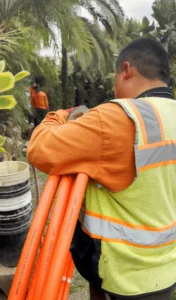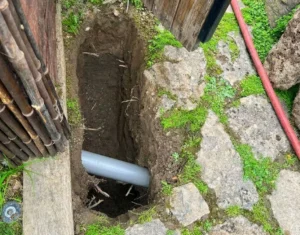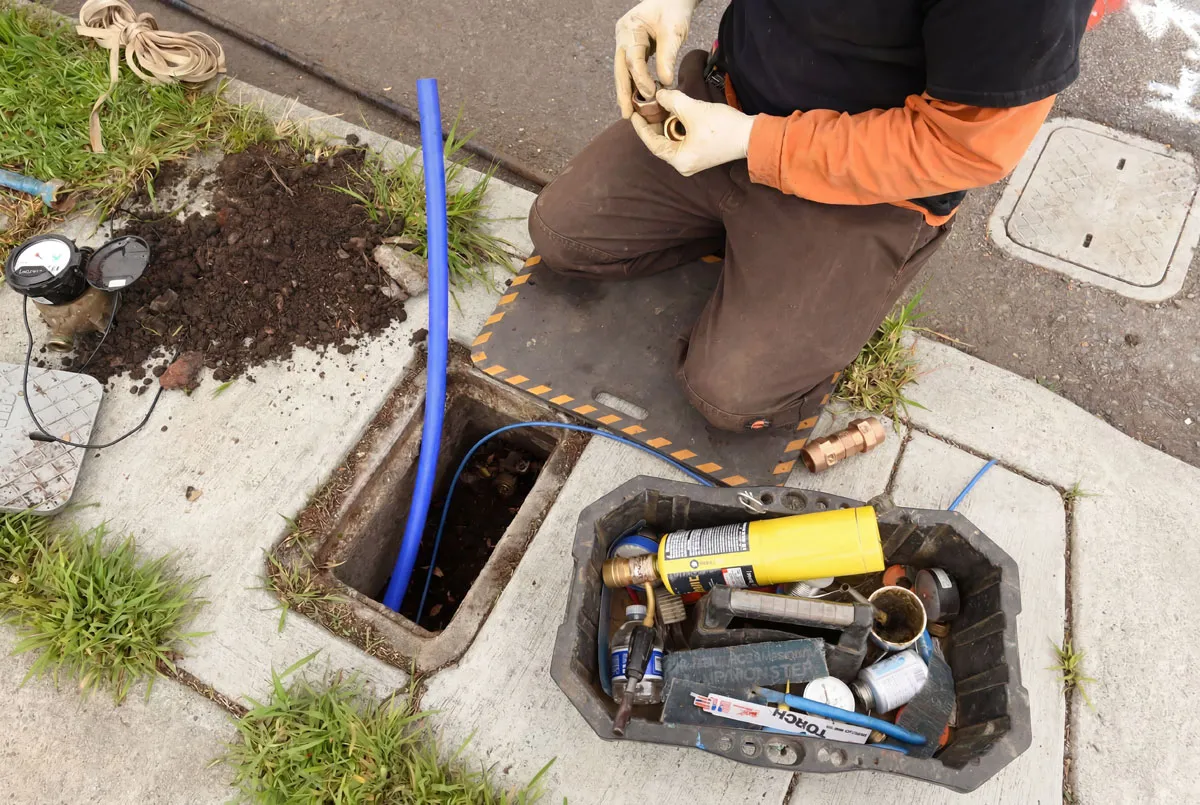
What Santa Clara County and San Mateo County property owners need to know before the work begins
A water bill that jumped without explanation. A soft, wet patch in a yard that wasn’t there last season. A contractor’s estimate that calls for tearing out a driveway to reach a pipe buried underneath. These are the moments when property owners in Santa Clara County and San Mateo County start looking for a better option. Trenchless water line replacement is that option in many cases—but not every situation. This guide covers how the trenchless replacement process works, what methods are used to install a new water line and when traditional excavation is still the right call.
What Trenchless Water Line Replacement Means
Trenchless water line replacement covers any method that repairs or replaces an underground water service or main without opening a full trench along the pipe’s path. Rather than excavating across a driveway or through landscaping, a trenchless crew uses small access pits, existing cleanouts or planned entry points to reach the pipe. The disruption footprint shrinks considerably.
That matters in the Bay Area, where mature landscaping, finished hardscape and dense utility corridors make traditional post open-cut work expensive. The goal is not to avoid all digging—it is to solve the pipe problem with as little surface damage as the site and pipe condition allow.
Common Signs a Water Line Needs Attention
Unexplained wet areas in a yard or near a foundation, a sudden increase in water bills, discolored or cloudy water, low pressure throughout a building, and repeated leaks in the same location are all signs that a water line may be failing. Older galvanized steel pipes—common in Santa Clara County and San Mateo County homes built before 1970—corrode from the inside over time, restricting flow and eventually leaking. For HOAs and commercial properties, the trigger is often a third or fourth repair call in the same area, which suggests a line-wide problem rather than isolated damage. A pressure test and utility locating review can clarify whether the issue is isolated or systemic before any work begins.
Traditional Repair vs. Trenchless Repair
Open-cut excavation involves digging a trench along the pipe’s route so crews can expose and remove the damaged section. It remains the right approach when a pipe has fully collapsed, when the alignment shifts unexpectedly underground or when site conditions block the access points that trenchless methods require. Trenchless repair uses those same small access points—pits at each end of the line, existing cleanouts or planned entry locations—and applies one of several methods depending on what the pipe condition warrants.
Pipe bursting threads a new HDPE pipe through the old line while fracturing the old pipe outward, useful when the existing pipe is structurally compromised. Pipe lining inserts a resin-impregnated sleeve that cures in place to form a new interior surface, useful when the pipe structure is still largely intact but leaking or corroding. Directional drilling installs an entirely new line along a different path, useful when the existing alignment cannot be used. The method follows the pipe condition—not the other way around.
When Trenchless Repair Is the Right Fit
Trenchless methods work well when the pipe route is reasonably straight, access pits can be excavated at each end and the existing alignment does not conflict with major utility crossings. Properties with concrete driveways, pavers, tile courtyards or established trees over the pipe path see the clearest benefit—restoring those surfaces after open-cut work adds significant cost and time. Lines running under active parking areas or shared HOA driveways are also strong candidates because trenchless work can often be completed with minimal closure.
Trenchless is not the right fit when the pipe has collapsed so severely that a new line cannot be pulled through, when the alignment changes direction in ways that require excavation to verify or when local permits specify open-cut methods for the work scope. The evaluation comes first. No assessment of fit is reliable without knowing the pipe material, condition and route.
Benefits of Choosing a Trenchless Approach
The primary benefit is surface preservation. Finishing a concrete driveway in Santa Clara County costs real money; avoiding that restoration entirely changes the project economics. For homeowners, that often means keeping mature landscaping and hardscape intact. For commercial tenants and HOA communities, it typically means fewer days with blocked access, less noise and a faster return to normal.
Trenchless work also produces a defined scope earlier in the process—because the pipe condition is evaluated before work begins, there are fewer surprises mid-project than with open-cut work where crews expose the line and discover additional damage. That predictability matters for budgeting and scheduling across any property type.
What Affects Cost and Timeline
Pipe depth and surface type are the two factors that most affect cost. A shallow galvanized line under a grass lawn is a fundamentally different project than a 6-foot-deep main under a concrete driveway. Beyond those, pipe length, diameter, material, the number of utility crossings encountered and the method selected all factor into the final scope.
In the Bay Area, expansive clay soils common in parts of Santa Clara County can affect excavation difficulty and pipe condition over time, which may add scope that is not apparent until the line is inspected. Permit requirements vary by municipality and can affect both timeline and cost.
Emergency stabilization work—when a line has failed and water service is interrupted—adds urgency that affects scheduling and crew availability. The range between a straightforward residential service line repair and a commercial main replacement serving multiple buildings is wide. An accurate estimate requires a site visit and pipe assessment, not a phone quote.
Why Work With TrenchFree?
TrenchFree specializes in underground pipe and utility work across Santa Clara County and San Mateo County. The team works with homeowners, HOAs, commercial property managers and municipal clients on projects ranging from single-family water service replacements to shared main lines serving multi-unit developments.
The process starts with understanding the specific site—pipe material, condition, access constraints and utility conflicts—before recommending a method. If pipe bursting or lining is the right solution, TrenchFree will explain why and what the work involves. If open-cut excavation is more appropriate for the conditions, that recommendation will reflect that reality rather than overselling a trenchless approach that does not fit.
Related TrenchFree Services