
Most homes built before 1975 in Los Gatos have underground sewer laterals and water lines that are at or past their expected service life. Clay pipe and cast iron degrade over decades; root intrusion, joint separation and corrosion are typical failure modes at this age. A trenchless repair—pipe lining or pipe bursting, depending on the pipe’s condition—addresses those failures without opening a trench across a yard, driveway or walkway.
Camera inspection is the starting point for most jobs. Video inspection of the lateral reveals the pipe condition and determines which method fits: pipe lining works best when the pipe is structurally intact but leaking or corroded; pipe bursting is used when the pipe is collapsing or has deteriorated beyond lining.
Traditional open-cut trenching requires excavating the full pipe route and restoring whatever surface sits above it. Trenchless methods use small access pits at each end of the run, leaving the surface between them intact. The sections below describe specific plumbing challenges by neighborhood and the TrenchFree approach for each.
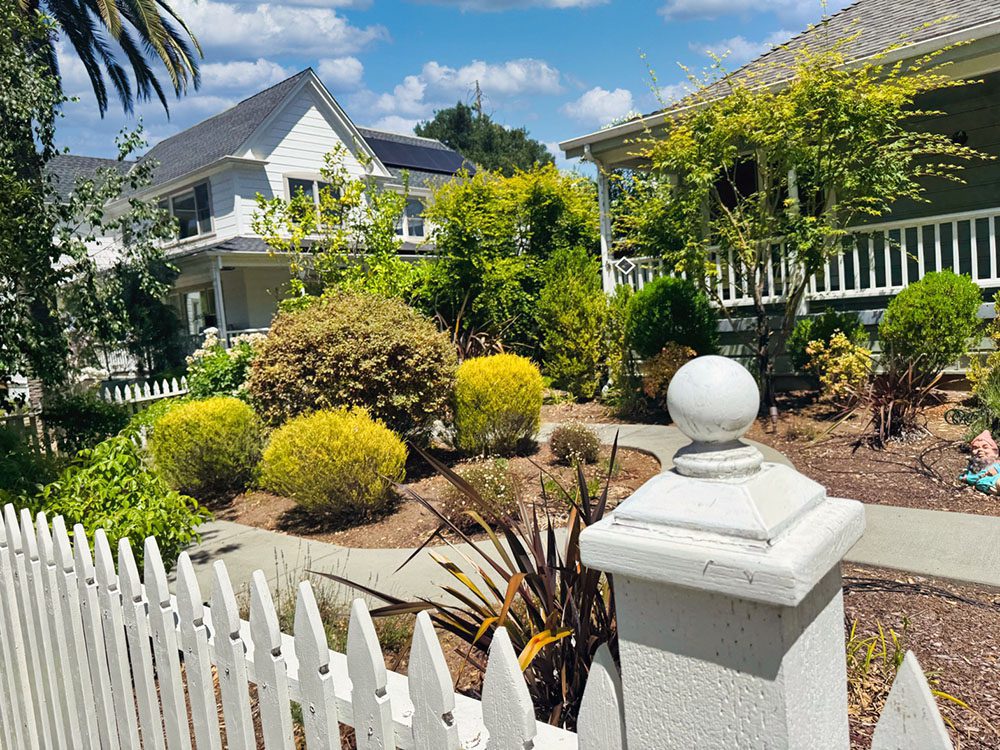
Build era: Mostly late 1880s–1920s (Victorian/Craftsman core).
Key streets: Tait, Bayview, Bachman, Broadway, Wilder, Almendra, Glen Ridge, Bean, Massol, Nicholson.
Underground plumbing profile:
TrenchFree solution: Lateral lining or pipe bursting for Almond Grove Historic District homes, keeping historic yards, gardens, driveways and brick walks intact.
Build era: The Broadway subdivision was created in Los Gatos’ earliest days, beginning in 1881; the homes largely date back to the 1880s–1920s.
Key streets: Broadway, Clifton Ave, Broadway Extension, Wood Rd (with nearby historic side streets).
Underground plumbing challenges:
TrenchFree solution: Spot repairs and lining solve chronic offsets and cracks without tearing up narrow streets or driveways.
Build era: Late 1800s–1910s core.
Key streets: University Ave (south of Hwy 9), Miles Ave, Miller Ave, Edelen Ave.
Underground plumbing challenges:
TrenchFree solution: CIPP lining for sewer laterals and small-pit water line replacement preserve yards and porches.
Build era: Park/plaza established 1915; many homes 1898–1930s, with limited infill later.
Key streets: Fairview Plaza, Fairview Ave, Pennsylvania Ave; pedestrian connection off Bayview.
Underground plumbing challenges:
TrenchFree solution: Pipe bursting (minimal pits) often ideal where full-diameter replacement is needed.
Build era: Mostly early 1900s–1930s, with some mid-century homes.
Key streets (representative): Glen Ridge Ave, Pennsylvania Ave, Ellenwood Ave, Hernandez Ave, Manzanita Ave, Laurel Ave, Bachman Ave, Wadsworth Ave, Chestnut Ave, Walnut Ave, Palm Ave, Peralta Ave, Overlook Rd, Apricot Ln.
Underground plumbing challenges:
TrenchFree solution: Directional drilling for water mains and lining for sewers avoid destabilizing hillsides and hardscape.
Build era: 1940s to mid-1950s.
Key streets: Loma Vista Ave, Linda Ave, El Gato Ln, parts of Escobar Ave.
Underground plumbing challenges:
TrenchFree solution: Full lateral lining is a clean fix for long runs under mature yards.
Build era: Primarily 1950–1956 ranch-era tract.
Key streets (representative): Longwood Dr (neighborhood edge), plus internal Blossom-era streets off Blossom Hill Rd.
Underground plumbing challenges:
TrenchFree solution: Pipe bursting or lining replaces failing laterals without disturbing front yards. Work requires only two small access pits at each end of the pipe run, which are easily patched and restored.
Build era: Mostly mid-1960s through 1970s; Surmont is among the earliest sections.
Key streets: Harwood Rd/Ct, Belgatos Rd, Belwood Gateway, Belridge Dr, Belvale Dr, Belvue Dr, Belblossom Dr, Bacigalupi Dr, Westhill Dr, Old Orchard Dr/Ct, Campos Verde Dr, Surmont Dr/Ct.
Underground plumbing challenges:
TrenchFree solution: Lining for root-damaged clay and bursting for collapsed segments are especially effective in Belwood, Belgatos and Surmont.
Build era: 1962–1965.
Key streets: Hillbrook Dr, Fairmead Ln, Eastridge Dr (plus short connectors).
Underground plumbing challenges:
TrenchFree solution: CIPP lining handles long root-intruded runs in Hillbrook without disturbing mature yards.
What is the difference between pipe lining and pipe bursting?
Pipe lining, also called CIPP or cured-in-place pipe, inserts a resin-saturated sleeve into the existing pipe and cures it in place to form a new pipe wall inside the old one. It works when the host pipe is still structurally sound. Pipe bursting pulls a new pipe through the old line while a bursting head fractures the old pipe outward into the surrounding soil. It is used when the existing pipe is collapsed, severely corroded or too damaged to line. Video inspection determines which method applies.
How long does a trenchless sewer repair take?
Many residential lateral repairs are completed in a single day once permits are in place and the line has been inspected and cleaned. Longer runs, multiple-segment failures or jobs requiring extensive cleaning can take additional time. Open-cut excavation, by comparison, often runs several days because of the digging and surface restoration involved.
Is trenchless repair available for homes in Los Gatos historic districts?
Yes. Trenchless methods are particularly well suited to historic neighborhoods such as Almond Grove, Broadway and the Edelen and University districts, where original landscaping, brick walks and tight setbacks make open excavation costly to restore. Because the work uses small access pits rather than a full trench, mature gardens and historic hardscape are largely preserved.
How is the right repair method determined?
A camera inspection of the line is the deciding step. The footage shows pipe material, the location and severity of damage, root intrusion and any bellies or offsets. That information determines whether lining, bursting, directional drilling or, in some cases, open-cut excavation is the appropriate method for the specific pipe and site.