Homes built before 1975 in Santa Clara County may contain one or more of the following pipe materials in their sewer laterals, drain lines and water service connections. Understanding these materials helps homeowners anticipate maintenance needs and replacement timelines.
Vitrified Clay Pipe (1880s–1970s)
Clay pipe is one of the oldest sewer pipe materials, with a history stretching back thousands of years. In Santa Clara Valley, vitrified (kiln-fired and glazed) clay pipe was the standard for municipal sewer mains and residential laterals from the late 1800s through the mid-20th century.
Characteristics and Problems with Clay Sewer Lines
Vitrified clay pipe is chemically inert and resistant to corrosion from sewage gases and acidic soils—advantages that made it the material of choice for generations. However, clay pipe has significant vulnerabilities. The pipes were typically manufactured in short sections (2–3 feet), joined with mortar or rubber gaskets. These joints can separate, crack or allow root intrusion over time.
Common issues include root penetration at joints, joint separation from soil movement or seismic activity, cracking from ground settlement and “bellying” where sections sag and collect debris. Santa Clara Valley’s seismic activity makes joint separation a particular concern.
Clay Pipe Use in San Jose
Clay pipe is prevalent in San Jose’s oldest neighborhoods—those built before World War II. Downtown San Jose, Japantown, Northside, Willow Glen’s historic core and the Naglee Park/East Santa Clara Street corridor typically have clay sewer laterals. Many municipal sewer mains installed by the City of San Jose before 1960 were also vitrified clay.
Expected lifespan is 50–100+ years for the pipe itself, but joints may fail sooner. Homes with clay laterals should have video inspections to assess joint condition and root intrusion.
Orangeburg Pipe (1940s to 1970s)
Orangeburg pipe was used in parts of Santa Clara Valley, especially in Mountain View, Sunnyvale, Fremont & Milpitas, mostly in private sewer laterals on mid-century homes.
The Orangeburg (“bituminous fiber” or tar-paper pipe) pipelines were widely installed in the U.S. from the 1940s through early 1970s, especially for house-to-street sewer laterals during the post-WWII housing boom. It was cheap and easy to cut, but deforms and collapses with age.
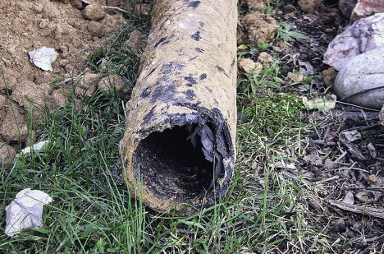
Orangeburg pipe was frequently installed for sanitary sewer main, water service lines and vent pipes from the 1940s to the 1970s. Use of fiber conduit or bituminous fiber pipe for sewer and water systems grew dramatically due to steel demand during World War II. The post-war housing boom resulted in its widespread use in residential construction.
Older San Jose/Santa Clara County neighborhoods constructed during the Valley’s huge 1945–1970 suburban buildout can have Orangeburg laterals. Even where codes were strict, builders sometimes still used Orangeburg for short private laterals, since they were cheaper and faster than clay or cast-iron mains.
The best way to determine the condition of materials is a physical inspection by a qualified underground plumbing specialist. They will often conduct a video inspection to determine the condition of the pipe throughout its length.
Galvanized Steel Pipe (1930s–1970s)
Primarily used for water supply lines, galvanized steel pipes are common in mid-century Santa Clara Valley homes and merit homeowner attention.
Galvanized steel pipes were zinc-coated to prevent rust, but this coating breaks down over time. Corrosion builds up inside the pipe, restricting water flow and eventually causing leaks. Water quality issues (discoloration, metallic taste, low pressure) often precede visible leaks.
Expected lifespan is 40–60 years. Homes built in San Jose between 1930 and 1970 with original plumbing likely have galvanized supply lines that are at or beyond their useful life.